Salary negotiation in IT: how to use the EU pay-transparency rules
Only 17.7% of German IT job ads state a salary. How the EU pay-transparency rules and job-ad salary ranges help you in a salary negotiation.

The EU Pay Transparency Directive gives applicants the right to learn the starting pay or its range and bars employers from asking about their pay history. Yet most IT job ads still name no figure: in Germany, only 17.7% of 6,104 IT ads in our data stated a salary.
The directive reaches you only through national law, and Germany, Austria, the Netherlands and Ireland are among the countries that had not transposed it by the deadline of 7 June 2026. Until the rules apply where you work, ads that do state pay are a concrete benchmark.
At a glance
- Directive (EU) 2023/970, Article 5: a right to the starting pay or its range; no questions about pay history
- Article 7: workers can request their pay level and average pay levels in writing
- Germany: no draft bill as of 12 November 2026; 17.7% of IT ads state a salary
- Poland: recruitment-stage pay information required since 24 December 2025; 23.5% of IT ads state a salary
What the directive gives you
Under Article 5, applicants have the right to receive the initial pay or its range, based on objective, gender-neutral criteria, in a way that ensures 'an informed and transparent negotiation on pay', for example in the job ad or before the interview. Article 5(2) adds that an employer 'shall not ask applicants about their pay history'.
Once you have the job, Article 6 obliges employers to make their criteria for pay and pay progression easily accessible, and Article 7 lets workers request their own pay level and the average pay levels, broken down by sex, for the same work or work of equal value.
Most IT ads still show no pay
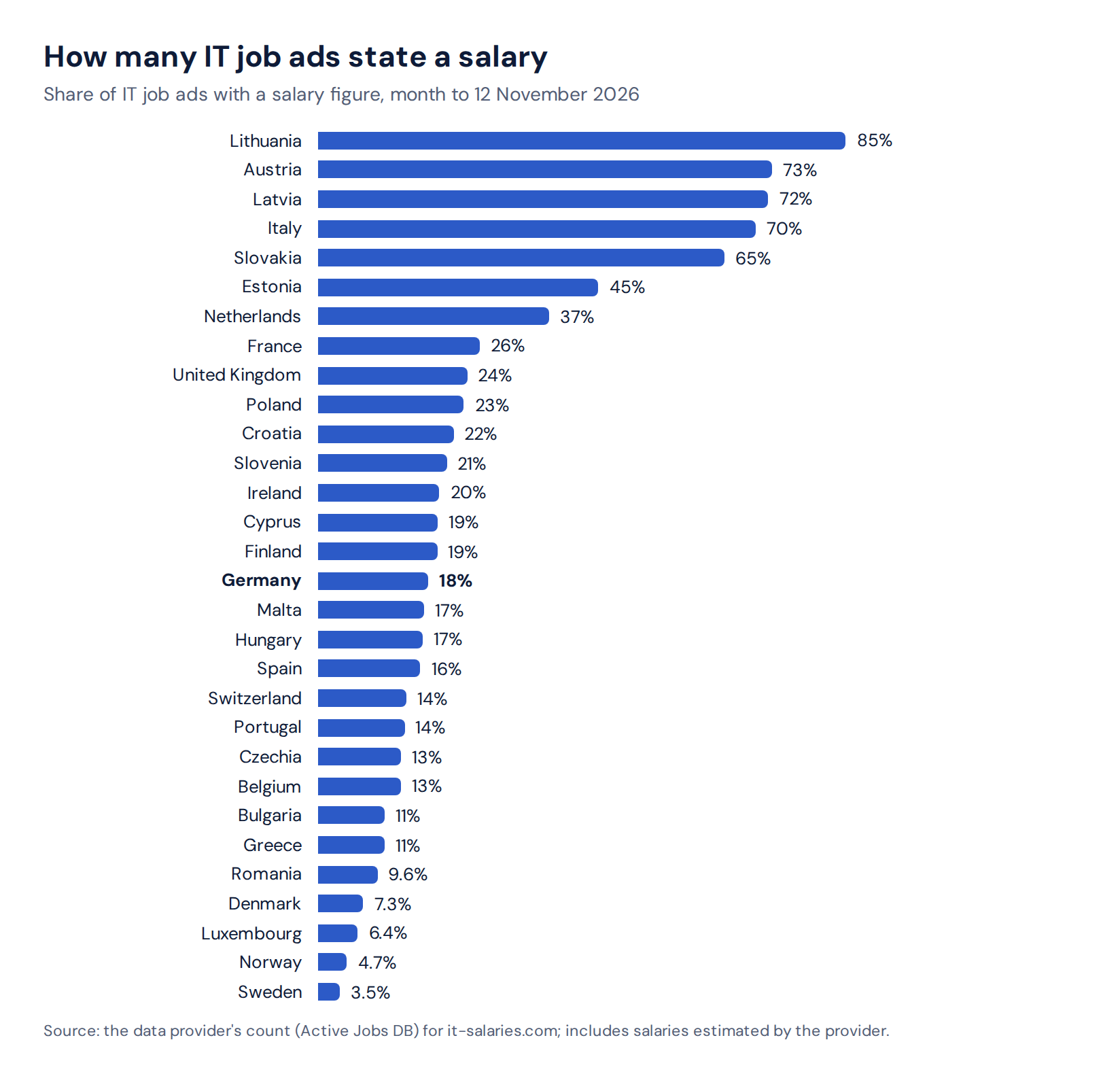
The chart shows the share of IT job ads that state a salary in 30 countries, with Germany highlighted. It ranges from 84.9% in Lithuania and 73.0% in Austria to 17.7% in Germany and 3.5% in Sweden.
A stated figure is not always an offer. Austrian law already requires every job ad to state the collective-agreement minimum and whether the employer is willing to pay more. Of 81 Austrian software engineer ads with a salary, 51% stated only that minimum.
Where national law stands
As of 12 November 2026, Poland applies the recruitment-stage rules: applicants must receive the starting pay or its range in the ad, before the interview or at the latest before the job starts. Germany had no draft bill, and its Pay Transparency Act of 2017 requires no pay information in ads. Austria, the Netherlands and Ireland have only drafts or bills. The UK and Switzerland are not bound by the directive.
Using job-ad ranges in a negotiation
Our salary pages show the median and the middle half of the offers (p25 to p75). For software engineers in Germany the median is €77,500 and the middle half €66,000 to €89,900 (141 ads). In Poland it is €64,200, from €45,400 to €78,700 (144 ads).
Use the range to place an offer. If an employer's range ends below the lower quartile, ask how it was set; if you aim for the upper quartile, prepare reasons such as the scope of the job or your specialism.
What this means for you
- Look up the median and middle half for your role and country before the first call.
- Ask for the range early and in writing. Where Article 5 is national law, as in Poland, you are entitled to it; elsewhere, ask anyway.
- If asked what you earn now, name the range you are looking for instead.
- In Austria, treat the stated minimum as a floor and ask how much more the employer will pay.
- Before a pay review, ask for the pay-progression criteria (Article 6) and, where the rules apply, the average pay levels (Article 7).
About this guide
This guide is based on Directive (EU) 2023/970, our pay transparency tracker as of 12 November 2026 and our job ads from 12 May to 12 November 2026. The facts were checked at the sources on 16 November 2026. The salaries are offered, not paid, and mix entry-level and senior roles; the data provider estimated 27% of the German and 25% of the Polish software engineer salaries from the ad text. See the methodology page. This guide is not legal advice.
Related salary data
Sources
- Methodology: how it-salaries.com gets its numbers · it-salaries.com · 2026-11-12
- Directive (EU) 2023/970 on pay transparency, Article 5: Pay transparency prior to employment · Official Journal of the European Union · 2023-05-10
- Directive (EU) 2023/970 on pay transparency, Article 6: Transparency of pay setting and pay progression policy · Official Journal of the European Union · 2023-05-10
- Directive (EU) 2023/970 on pay transparency, Article 7: Right to information · Official Journal of the European Union · 2023-05-10
- Directive (EU) 2023/970 on pay transparency, Article 34: Transposition · Official Journal of the European Union · 2023-05-10
- Pay transparency in Germany · it-salaries.com · 2026-11-12
- Pay transparency in Austria · it-salaries.com · 2026-11-12
- Pay transparency in Poland · it-salaries.com · 2026-11-12
- Pay transparency in the Netherlands · it-salaries.com · 2026-11-12
- Pay transparency in Ireland · it-salaries.com · 2026-11-12
- Pay transparency in the United Kingdom · it-salaries.com · 2026-11-12
- Pay transparency in Switzerland · it-salaries.com · 2026-11-12
This article was written with AI assistance, based on the sources listed and on it-salaries.com data. Methodology